Alnico Magnets: The Complete Guide to Grades, Properties & Applications
Alnico is one of the oldest engineered permanent magnet materials still in everyday industrial use, and for a specific set of design problems it remains the best choice available. It does not have the raw strength of a neodymium magnet, but it holds its output across temperature better than any other standard production magnet, and it contains no rare earth elements. This guide covers the grades Dura Magnetics produces, the magnetic and thermal properties that define them, the design tradeoffs that matter, and where Alnico earns its place in a design.
What Is Alnico?
Alnico is an iron-based alloy named for its three primary additions: aluminum, nickel, and cobalt, with cobalt typically running anywhere from about 5% to 24% by weight, plus minor copper and titanium. That composition gives the material a high residual field and, importantly, excellent stability at elevated temperature.
Alnico is produced two ways, and the method affects both performance and part design. Cast and sintered Alnico differ as follows:
Cast Alnico is poured into sand molds. It reaches the highest magnetic properties and supports complex shapes and larger sizes, but it is brittle and finished by grinding.
Sintered Alnico is pressed from metal powder and sintered to near net shape. It holds tighter tolerances and is mechanically stronger, which suits small, high-volume parts, at the cost of somewhat lower magnetic output.
Most Alnico is also anisotropic (oriented): during heat treatment the alloy is cooled in a magnetic field, developing a preferred axis that roughly triples its output along that one direction. The magnet must then be magnetized along that axis. Lower grades such as Alnico 2 are isotropic (unoriented), weaker but magnetizable in any direction.
What Are the Alnico Grades?
The number in an Alnico grade is an MMPA designation, not a linear strength rating. It identifies a specific composition and process recipe. Dura produces the full range of cast and sintered grades: Alnico 2, 5, 5-7, 8, and 9.
The table below lists representative properties for the cast grades. Values are stated in CGS units (Gauss, Oersted, MGOe) with Tesla in parentheses, consistent with how magnet datasheets are published.
Grade
Residual Induction Br
Coercive Force Hc
Max Energy Product (BH)max
Max Operating Temp
Type
Alnico 2
7,200 G (0.72 T)
~560 Oe
1.5 to 1.7 MGOe
~450°C
Isotropic
Alnico 5
12,500 G (1.25 T)
600 to 640 Oe
5.0 to 5.5 MGOe
~525°C
Anisotropic
Alnico 5-7
13,000 to 13,500 G (1.30 to 1.35 T)
700 to 740 Oe
~7.5 MGOe
~525°C
Grain-oriented
Alnico 8
8,000 to 9,000 G (0.80 to 0.90 T)
1,500 to 1,650 Oe
5.0 to 6.0 MGOe
~550°C
Anisotropic, high coercivity
Alnico 9
10,500 to 11,200 G (1.05 to 1.12 T)
1,375 to 1,500 Oe
9.0 to 10.5 MGOe
~550°C
Grain-oriented, high coercivity
Curie temperature is roughly 860°C across these grades, since it is set largely by the iron-cobalt base alloy. Sintered versions of the same grade run lower in Br and energy product, typically by 10% to 25%, with coercivity and Curie temperature largely unchanged.
A useful way to read the table: Alnico 5 is the workhorse, the grade behind the classic horseshoe magnet, with high field and modest coercivity. Alnico 5-7 and Alnico 9 are grain-oriented premium grades that push energy product higher and are effectively cast-only. Alnico 8 trades field strength for much higher resistance to demagnetization.
Why Does Alnico Have High Strength but Demagnetize Easily?
This tradeoff is the single most important thing to understand about designing with Alnico. The material has a high residual induction (Br) but a low coercive force (Hc). In plain terms, it produces a strong field but gives that field up easily when exposed to an opposing field, or even to its own demagnetizing field in an open magnetic circuit.
Alnico 5 has higher Br but lower Hc. It delivers a stronger field when the magnet geometry and circuit keep its operating point high.
Alnico 8 has lower Br but substantially higher Hc. It holds up far better in short magnets, less-than-ideal geometries, or in the presence of opposing fields.
Strong magnets that easily demagnetize are not useful, and neither are weak magnets that resist demagnetization. The right Alnico grade is the one that keeps a usable field at your operating point.
How Does Alnico Perform at High Temperature?
This is where Alnico has no real competition among standard production magnets. It offers the best temperature characteristics of any common permanent magnet material. Dura rates Alnico for continuous-duty service to 500°C (930°F), and per-grade limits run as high as about 550°C for the higher grades. Its reversible temperature coefficient of induction is roughly −0.02 %/°C, the lowest (best) of any production magnet, meaning its output drifts very little as temperature changes.
For comparison, standard neodymium magnets are far stronger at room temperature but begin to lose output irreversibly near 80°C and have a temperature coefficient several times worse. Samarium cobalt is the other high-temperature option and is stronger than Alnico, but where temperatures climb toward and past Alnico’s range, Alnico is frequently the simplest, most stable answer.
Two practical cautions: cooling below ambient is rarely a problem for Alnico, but each circuit should still be evaluated, and exposure above roughly 1000°F causes permanent metallurgical change that can only be reversed by re-heat-treating.
How Do You Design With Alnico?
Two physical realities shape every Alnico design.
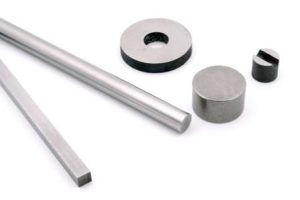
Geometry matters more than with other materials. Because coercivity is low, a magnet that is short relative to its pole face sits at a low, vulnerable point on its demagnetization curve and can partially demagnetize itself. The fix is geometric: keep the magnet long in the direction of magnetization. A common rule of thumb is a magnetic length-to-diameter (L/D) ratio of about 4:1 or greater, which is exactly why Alnico is so often seen as long bars, rods, and horseshoes rather than thin discs. Treat the specific ratio as application-dependent.
Alnico is hard and brittle. It cannot be conventionally machined or drilled; features and close tolerances are produced by abrasive grinding (and methods such as EDM), while looser features can be left as-cast. Alnico 8 is more prone to chipping than Alnico 5, which is worth keeping in mind on any grade above 6.
Dura casts and sinters Alnico, holds drawings dating back decades, and can supply parts made to your print or provide design assistance on grade, geometry, and magnetization.
Where Are Alnico Magnets Used?
Alnico shows up wherever stability and temperature survival outrank maximum flux density:
Sensors and instrumentation, where consistent output over years and over temperature is the priority.
Motors, generators, and magnetos, including rotating equipment under thermal and mechanical stress.
Holding, separation, and lifting assemblies, including the classic horseshoe holding magnet.
Guitar pickups, a legacy and tonal application where specific grades are chosen for their sound rather than their numbers.
Aerospace, defense, industrial, and scientific equipment where high-temperature stability or legacy compatibility is required.
There is also a current sourcing angle. Alnico contains no rare earth elements, so it sits outside the rare-earth export controls that have disrupted neodymium and samarium cobalt supply. That is a genuine advantage, with one caveat: Alnico’s cobalt content ties it to its own concentrated and currently volatile supply market. Alnico de-risks rare-earth exposure; it does not eliminate critical-mineral exposure entirely.
Specifying Alnico for Your Application
The right Alnico grade depends on your field requirement, your operating temperature, the space and geometry you have, and your circuit. Getting that combination right is exactly the kind of problem Dura Magnetics solves. Dura designs, casts, sinters, and finishes custom Alnico magnets in-house, and supplies them DFARS, RoHS, and REACH compliant for aerospace and defense programs.
Each of the wide variety of magnetic materials available requires specific storage and handling procedures for both the safety of the user and integrity of the magnet. Why handling and storage conditions are important Improperly handled and stored magnets present risks: Risk of bodily harm or injury Risk of damage to the magnet Risk of...
Choosing an appropriate magnet material is a crucial part of the design of a magnet assembly, as it will largely impact the performance of the final product. Here are a few tips from Dura’s decades of design experience to consider when selecting a material and grade for your assembly. Considerations for choosing a magnet type...
While some rare-Earth materials have surpassed Alnico in popularity, it remains a key magnet material vital to certain industries, particularly those required to maintain DFARS compliance. At Dura Magnetics, we have USA-produced Alnico raw material available upon request. While the material itself poses a somewhat difficult and unique machining challenge, our team has the experience...